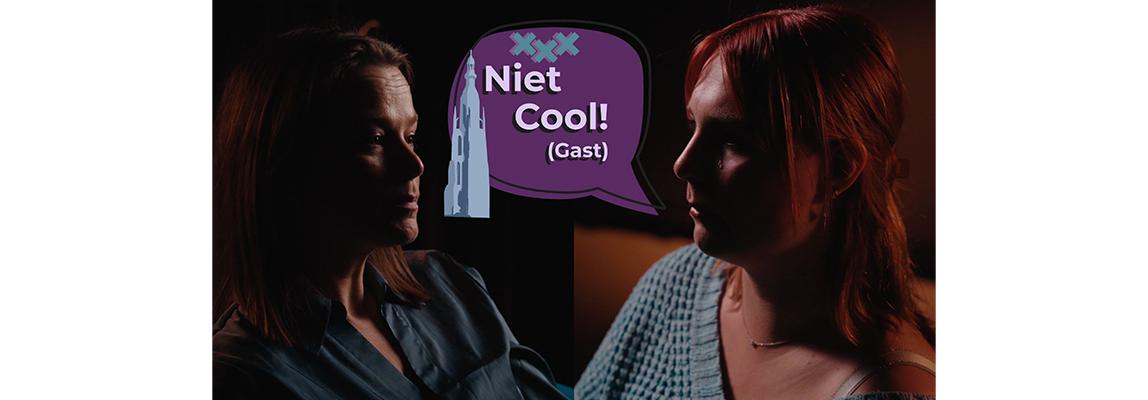
Students shine light on women’s safety in Breda with documentary ‘Niet Cool (Gast)!’
01/29/2026 - 13:21

- Stories
- Student work
What inspired you to create this documentary?
Storm: 'The assignment actually came from our Creative Collective course, which is part of the new Creative Business curriculum. We had the freedom to choose a passion project, as long as it was media-related. We started in early September 2025, right when the situation with 17-year-old Lisa from Abcoude was happening in the Netherlands. We felt there was momentum around this topic, and we genuinely wanted to make a change. That’s how the idea started, the topic was decided quite early on.'
Lea: 'I was discussing this with my friend in Germany, and she hadn’t heard about it at all. But in the Netherlands, it was huge with the “Wij eisen de nacht op” movement. It’s an important topic everywhere, really.'
How did you approach making a documentary on such a sensitive subject?
Storm: 'We chose to make it in Dutch because we wanted it to be shown in high schools in Breda specifically. We ended up making a half-informational, half-emotionally impacting film. We wanted to focus on the human side.'
Lea: ' We initially had ideas like talking to victims or even interviewing perpetrators, but we realised we didn’t want to give perpetrators a platform. We also considered revisiting places where harassment had happened with participants to explore what emotions and thoughts might surface, but that felt too confrontational. Talking about these experiences can be quite retraumatising and challenging for victims.'
Storm: ‘As our target audience, we ultimately chose to focus on men who may be aware of the issue but do not yet recognise how their own behaviour contributes to it, or how they can change. We wanted younger men, and men in general, to think about their role. That’s why I appear in the documentary, showing my own learning process. Hopefully, men watching will think they can go through that journey too.'
What was the most challenging part of the production process?
Lea: 'Finding people who were open to talk about their experiences was difficult. We had to be very careful about how we approached participants.'
Storm: 'We learnt a huge lesson early on. We met with one student from BUas who was willing to share her story. We were too excited and too pushy in that first meeting, we made her relive her experience, and she started crying. That was a wake-up call about how we needed to approach this differently.'
Lea: 'You really need to build a relationship with the person first. We were too caught up in our own concept ideation. One of our classmates had experience with harassment and offered to help us with advice on how to approach these conversations and make people feel comfortable.'
Storm: 'Nina Saunders also taught us about trauma-informed interviewing, how certain questions can come across. These were big learning moments, both for filmmaking and understanding the topic itself.'
What roles did each of you take on?
Storm: 'I was the director, amongst other things. Since we were a group of three, I took on multiple roles. I had the most knowledge about filmmaking and audiovisual work, so I was the creative mind behind the storytelling. I also appear in the documentary as a presenter. Some production roles like director of photography and filming fell to me as well.'
Lea: 'I was the producer, handling anything related to managing and organising, getting participants, being in contact with BO Diversity and stakeholders, planning, budgeting, all of that.'
Storm: 'Jur Gust was the third member of our team. He was our marketing person, handling fundraising and social media. On production days, he jumped in on audio and helped wherever needed.'
What was the most valuable thing you learnt from this project?
Lea: 'For me, I already knew this issue existed, but being confronted with it every day whilst making the documentary really scared me. I always felt safe in Breda, but through our interviews with women, I realised how “normal” this is. We made this documentary to have some sort of hope and be active about creating change.'
Storm: 'It’s hard to put a finger on one specific thing because I learnt so much about the types of things women encounter. In the span of three or four months, I spoke to more women on this topic than ever before in my life. I learnt what it feels like to be harassed. I was shocked by how much it happens in Breda. The pyramid of violence was new to me, it comes back in the documentary and really helped me understand the topic. I learnt how to avoid being intimidating as a man. I already knew about calling out other men, but I didn’t realise that even a small joke could be harmful. Now I would call that out much earlier.'
How are you planning to distribute the documentary?
Lea: 'We’re in contact with a council member from Breda who handles street harassment policy to explore possibilities. One is particularly interested in the educational aspect. We’re also speaking with a policy adviser to the Minister of Education, Culture and Science.'
Storm: 'Through the municipality, we hope to screen it at high schools in Breda. Our semester is over now, so whilst we thought about distribution, the execution is up to us, it’s not graded. We’re also in contact with International Women’s Day organisers who are doing a festival at the Filmhuis Breda, and with BO Diversity about potential screenings. It’s all in the making now.'
Update (3 March): The short documentary Niet Cool! (Gast) will be shown at the International Women's Day Festival at Filmhuis Breda on Sunday, 8 March, at approximately 13:30h. Entry is free and everyone is welcome to join.
What’s next for you?
Storm: 'I’m doing my graduation project with an organisation called Kalinga, which runs an elementary school in the Philippines, north of Manila. The school offers education to children who otherwise would have to work on the land. I’m making a documentary for them, promotional content for their website and fundraising events. Storytelling is one of the strongest tools out there, and it’s my passion to use it to do good.'
Lea: 'I’ll be staying in Breda and working at Frontaal, the beer brewery. I’ll be in their marketing department handling their marketing and social media strategy.'
Connect with Storm and Lea on LinkedIn, or visit Storm's portfolio website:
https://www.linkedin.com/in/lea-suzanna-häuser-59639b360
https://www.linkedin.com/in/storm-limbeek-234672251/
https://www.instagram.com/nietcoolgast/