[node:title]

Frigyes Stupek on using VR and AR to support addiction recovery

02/04/2026 - 09:19

Frigyes Stupek is a master’s student in Media Innovation (MMI) who combines a background in communication and media with emerging immersive technologies. As an intern at BUas’ R&D department Cradle and within the RECOVRY programme, he is researching and designing extensions to an existing VR-based intervention, expanding its scope beyond alcohol to include cigarette smoking and other substance-related addictions.
Media
  • Research
  • Stories
  • Student work

Can you introduce yourself and your background? 

Frigyes: ‘I am currently a Media Innovation master’s student and still completing my thesis. Before starting the programme, I studied communication and media studies and worked as a marketing manager for an independent film distribution company. I did not have much experience with VR or AR at the time, so moving into this field has been both challenging and exciting.’ 

How did you become involved in the RECOVRY programme? 

Frigyes: ‘During the programme, different research facilities and projects were presented, including the work at Cradle and the RECOVRY application. When thesis topics were introduced, this project really stood out to me. In a way, the topic found me rather than the other way around, and I immediately wanted to be part of it.’ 

What is the RECOVRY application and what was your role within the project? 

Frigyes: ‘RECOVRY is an existing application that supports people recovering from alcohol addiction by helping them practise resisting alcohol in everyday situations. My role was to research and design ways to extend the programme beyond alcohol, with a particular focus on cigarette smoking addiction. I worked on creating new scenarios and design approaches that could be integrated into the current system.’ 

Why focus on smoking addiction? 

Frigyes: ‘Smoking is still extremely harmful and very widespread. From my perspective, immersive technologies should not only be used for entertainment, but also to make a meaningful impact. Using VR and AR to support people who want to quit smoking felt like a powerful and responsible application of these tools.’ 

How did you test your designs and gather data? 

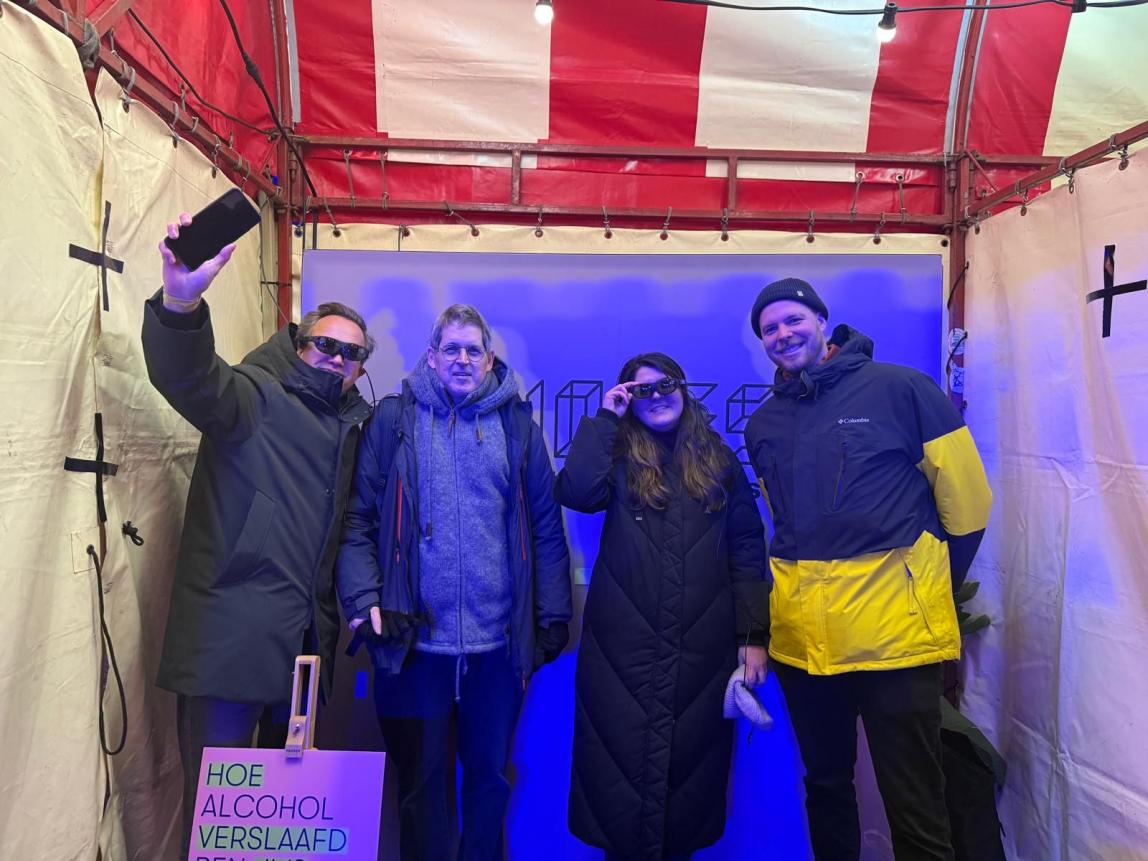
Frigyes: ‘We tested early designs at a festival, where participants could experience the application using different AR and VR headsets. We used both quantitative methods, such as questionnaires before and after the experience, and qualitative interviews. People were genuinely interested and very open to participating, which gave us valuable insights.’ 

‘The team at the festival consisted of four members, including myself. Of course, the wider RECOVRY team is much larger, as it also includes all developers involved in building and maintaining the application. On-site, Shima Rezaei Rashnoodi was present as the head of the research, together with Marnix S. van Gisbergen. They are both professors and lecturers at Breda University of Applied Sciences. Victor J.A. Buwalda was also part of the team. He is the Acting Medical Director at the Office of Mental Health in Amsterdam and is responsible for the project’s ethical and psychological credibility.’ 

Did you notice differences between different countries? 

Frigyes: ‘The project is based in the Netherlands, but I also conducted interviews in Hungary. The reactions and experiences were quite similar, although people in the Netherlands generally seemed more familiar with VR and AR technologies. Overall, the insights from both contexts were very valuable for the research.’ 

What has this project meant for you personally and professionally? 

Frigyes: ‘Coming from a non-technical background, working hands-on with immersive technology was a major learning experience. It showed me that these tools are more accessible than I initially thought. The project also changed how I see my future; I can now imagine myself continuing in an academic or research-oriented career, focusing on meaningful and socially relevant applications of technology.’ 


You can learn more about Frigyes Stupek and his work via his LinkedIn profile: https://www.linkedin.com/in/frigyes-stupek/